https://english.alarabiya.net/en/features/2017/11/20/Church-closures-in-Egypt-We-were-silent-when-it-was-one-now-it-s-four-.html
Church closures in Egypt: ‘We were silent when it was one, now it’s four’

A Coptic Christian priest blesses his congregation with holy water
during Sunday service in the Virgin Mary Church at Samalout Diocese in
Al-Our village, in Minya governorate, south of Cairo. (Reuters)
“We said nothing when one church was closed, so it got worse and a
second, then a third were closed, and a fourth is on its way as if
praying is a crime for which Copts are punished,” said a statement
issued by the Diocese of Minya in Upper Egypt.
The
statement listed the names of the four churches, two of which were
closed after being attacked by extremist Islamists, the third closed in
anticipation of an attack that never materialized, and the fourth was
besieged by security forces following an attack and is expected to be
closed. “We are concerned that extremists will be able to impose their
will on state institutions,” the
statement added, calling upon the governor and security entities to interfere.
The
statement issued by the governor of Minya in response gives, however, a
totally different picture. According to the statement, the buildings
that were attacked were houses in which prayers were performed without a
license. “Two houses were attacked. Security forces arrested 15
suspects in the first and 11 in the second,” said the statement. “As for
the other places, they were also houses owned by Copts but were not
attacked at all.” The statement added that the governorates responds to
all requests for the construction of churches and makes sure that their
number is proportional to population increase.
“In
fact, Minya governorate has the biggest number of churches,
monasteries, and Coptic community service centers,” added the statement,
which also called upon the diocese to verify the information it has.
Bishop of Minya Makarios
said he
would not comment on the governor’s statement. The dispute about
whether the targeted buildings were actual churches or houses used for
prayers started a debate over the legal status of churches and the
long-overlooked licensing ordeal.
The “war of statements,” as journalist Mohamed Youssef
puts it,
signals the beginning of a rift between state and church officials.
“The governor’s statement angered a lot of Coptic activists who called
upon President Sisi to personally intervene through forming a neutral
committee to look into the crisis in Minya,” he wrote. “Many of those
activists believe that the new law on the construction of churches has
not so far solved any of the problems pertaining to the legal status of
churches.”
It is noteworthy, Youssef
added, that neither Pope Tawadros nor the Coptic Orthodox Church have
issued any statement on the matter while Bishop Makarios is the only one
in charge. “The Pope has most likely assigned Bishop Makarios the task
of speaking in behalf of the Copts of Minya and putting pressure on the
governorate to reopen the churches and legalize their status,” he said.
“The Pope does not want the matter to be escalated to a dispute between
the church and the regime so he preferred to deal with it on a more
local level.”
Journalist Girgis Bishry,
who criticized the governor’s statement, argued that the absence of
licenses was just a pretext used by the governorate to close the
churches and that the whole situation was not dealt with in accordance
with the law. “The governor resorted to reconciliation sessions between
the assailants and the victims in order to solve the problem, which
basically means that the perpetrators get away with what they did,” he
wrote.
Bishry
noted that
Minya is the most affected by sectarian violence among Egypt’s
governorates, with more than 64 churches burnt following the dispersal
of the Islamist sit-in staged in protest of toppling the Muslim
Brotherhood and attacks targeting churches and Copts still taking
places. “This means that Minya is a hotbed of extremists and there is a
possibility that the governorate itself is infiltrated by Muslim
Brotherhood supporters who intentionally turn a blind eye to such
violations,” he added. “If this is not stopped, we might wake up one day
to find Minya an Islamic state.”
MP and political analyst Emad Gad
explained that
the law on the construction of churches, issued in 2016, is divided
into two parts: the first is issuing licenses for new churches and the
second is legalizing the status of already-existing churches. “Almost
half Coptic Orthodox churches are not officially licensed,” he wrote.
“Some churches had all the documents completed before starting
construction and got permission for construction, but the Security
Bureau never gave the actual license so that church remained technically
without papers.
Other churches were built
without any documents to start with because of the many obstacles
security entities placed in their way and these became a matter of
fact.” Gad added that the Coptic Orthodox Church submitted a list of
unlicensed churches so that they can be legalized, but instead of
starting the process of issuing licenses, local authorities started
closing them because they are not licensed. “Those authorities totally
overlook the fact that such actions are bound to increase sectarian
tension as Copts would once again fell deprived of their citizenship
rights, on top of which is the right to practice their faith.”
A
report by
Girgis Safwat, Teresa Shenouda, and Ali Hussein quotes sources from the
Coptic Orthodox Church as saying that the Diocese of Minya sent to the
special committee established by the cabinet the document for 50 houses
that turned into churches so that their status can be legalized. “Those
were originally small houses that parishioners started using over the
years for prayers with unofficial security approval so they gradually
acquired the status of churches,” the sources said. “Ownership documents
were submitted to the committee so that licenses can be issued and the
houses can acquire the official status of churches.”
Meanwhile, lawyer and head of the Egyptian Center for Developmental Studies and Human Rights Joseph Malak sent official
warnings to
the Egyptian prime minister and ministers of interior, parliamentary
affairs, and local development to demand stopping the closure of
churches and the re-opening of any closed churches.
“This
demand is based on the 2013 constitution and law number for the year
2016 on the construction of churches as well as ministerial decree
number 199 for the year 2017, which stipulates legalizing the status of
existing churches and particularly articles 8, 9, and 10 which consider
all existing churches legal,” said the warning.
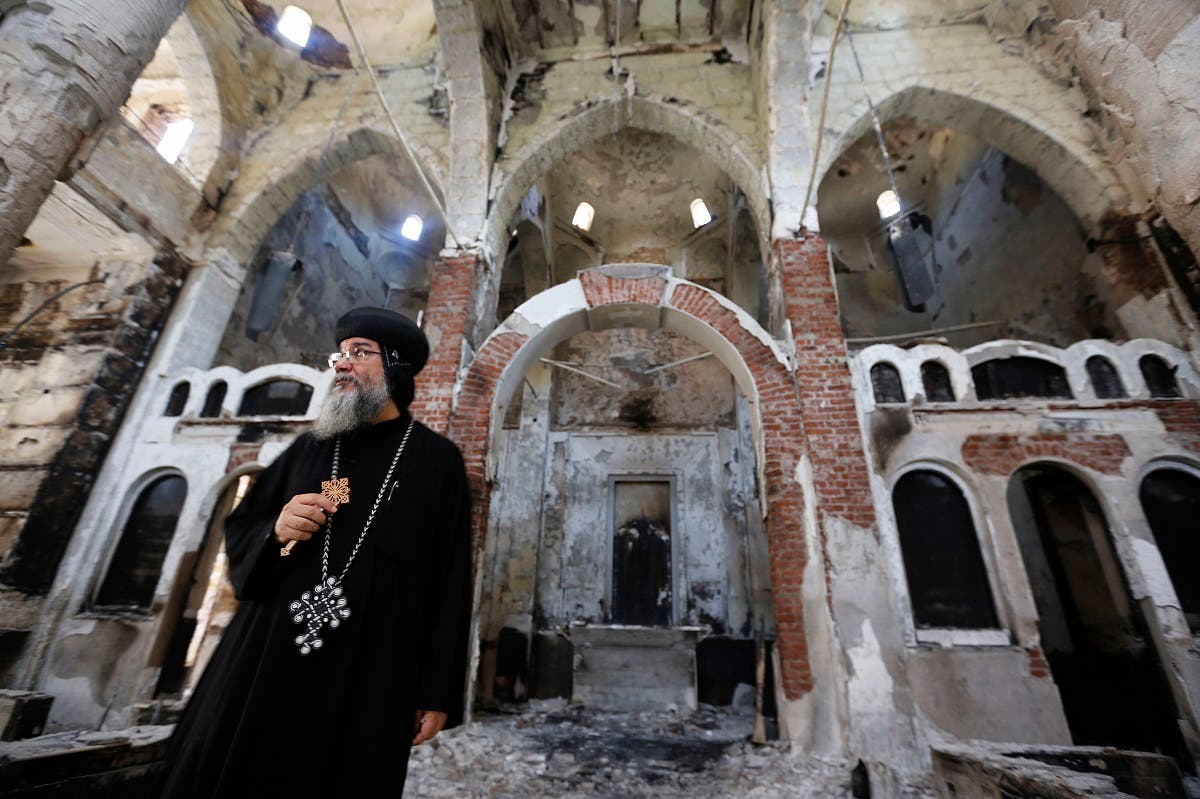 Bishop-General Macarius, a Coptic Orthodox leader, walks around
the burnt and damaged Evangelical Church in Minya governorate, about 245
km (152 miles) south of Cairo, August 26, 2013. (Reuters)
Bishop-General Macarius, a Coptic Orthodox leader, walks around
the burnt and damaged Evangelical Church in Minya governorate, about 245
km (152 miles) south of Cairo, August 26, 2013. (Reuters)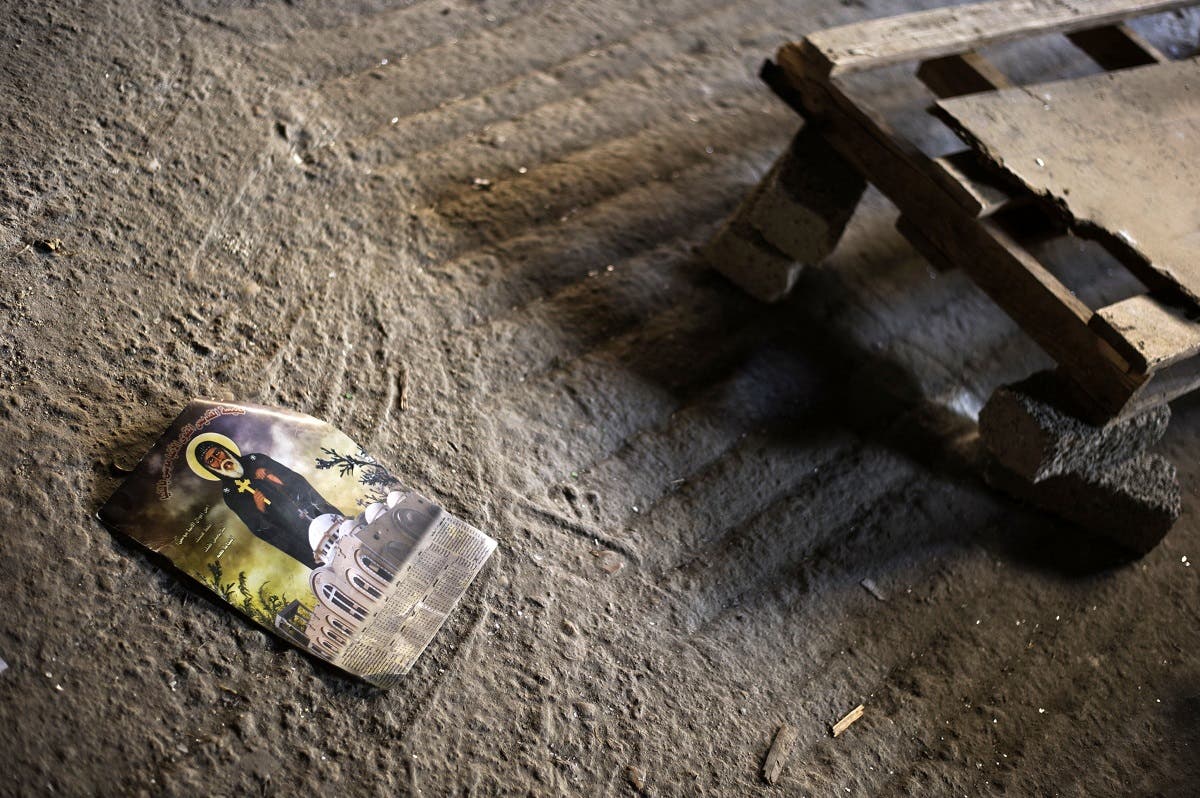 A religious picture remains on the ground on August 27, 2013 in
the central Egyptian city of Minya inside Amba Moussa Coptic church that
was vandalized and torched by unknown assailants. (AFP)
A religious picture remains on the ground on August 27, 2013 in
the central Egyptian city of Minya inside Amba Moussa Coptic church that
was vandalized and torched by unknown assailants. (AFP)

No comments:
Post a Comment